As I am sure many of you did, I watched the recent U.S. Women’s Open Championship held at Shoal Creek and I was in awe of the players’ abilities. The level of skill was not only amazing but truly elite in stature. I don’t know about you, but I became exhausted just watching them playing not only in the heat but battling the bugs, enduring tough course conditions and planning each shot to be as technically perfect as possible. Watching the players walk hole to hole and back again during the playoff was enough to make me go to the kitchen for a tall glass of lemonade to cool off.
Unquestionably, the tournament showcased the elite level of golf to which we have become accustomed to on the LPGA tour. Honestly, from the play I observed during the recent Curtis Cup at Quaker Ridge Golf Club, the players are shaping the future of women’s golf to be extraordinary. So, how would you describe current players in the LPGA? Would it be strong? How about determined? Competitive? How about cute and bubbly?
Unfortunately, female athletes, no matter the sport or level of play, are framed and described differently than male athletes. This has been proven time and time again in the academic world. This framing originates from many sources. While media has contributed to this different and even negative framing, another contributor to this problem are TV commentators/announcers/broadcasters.
TV Commentators are an often overlooked aspect of sport in this regard. The manner in which they call the game, the words they use and their tone, are all ways in which athletes are framed and presented to the viewer. Announcers can be exciting, informative and can even make or break a broadcast in terms of the financial success of the network airing the event. However, many studies have shown the covert and blatant sexism of sports announcers. We have seen in the academic literature for years that women in sport are often described in an emotional manner or are framed within a relationship context such as “mother” or “wife” with little to no acknowledgment of athleticism. One study (Billings, et al, 2014) showed after analysis of the 2012 London Olympic Games, that even though women’s sports received more air time, women athletes were more often framed within an emotional context and had more comments made about their appearance. (For the record, women’s shooting received 75 seconds of airtime while beach volleyball was a major focus with significant airtime. You can decide why that may have been.) Or, does anyone remember in 2015 when commentator Ian Cohen asked tennis player Eugenie Bouchard to “twirl” for the crowd to showcase her clothes just after she basically crushed her opponent? Would he ask Roger Federer to do the same thing?
How about golf? How Do Sports Analysts Frame Professional Women Golfers?
In a study entitled, “Television coverage of professional golf: A focus on gender” authors Weiller and Higgs analyzed 2 LPGA events and 2 PGA events to discover how commentators spoke about players and any other differences in coverage. The following are some notable results:
Visual Framing
- The leaderboard was shown more frequently during men’s events. The leaderboard for the women tended to be shown at the end of major time segments.
- Club selection was mentioned more often in men’s broadcasts.
- Seven commentators were used in the men’s events. Women’s events had a total of eight commentators with only two being women.
- Graphic visuals (hole difficulty, player’s position) were used only in the men’s events.
Verbal Strength Framing
The men’s events featured more strength descriptors. For example, “macho” and “two of the most powerful players in the game” were said. In the women’s events, the commentators framed the players in a more ambivalent tone. For example, “She’s a delightful lady who can sure launch it in the air.”
Viewing Time Difference
Men’s events received 17.5 hours of viewing time while the women received 9 hours.
Use of First and Last Names
Commentators generally used first names for female players. Nicknames were often used for the men. As the authors note, “although perhaps a minor point, this suggests a level of recognizability for the male golfers which commentators assumed would not be present for the female golfer” (p.6).
Commentator Description of Athletes
- Commentators consistently gave personal information during women’s events. While this is often done to enhance the emotional aspect of sport broadcasting, women’s descriptors were different from men’s. For example, in one tournament, Juli Inkster was referred to as “the mother of two children” and when she made a shot not to standard, “family” was offered as the excuse. Another comment about another female player was, “she had a son in March and is now trying to get back in shape.” In addition, a commentator questioned a player on how she felt after having a baby, “whether motherhood has taken precedence over golf” and then proceeded to talk about her smile and clothing. Only three times was a male golfer’s personal life referenced.
- The men were sometimes described as where they went to college. The women were sometimes referenced in regard to their marital status, clothing and appearance.
Gender Marking
- Viewers were reminded often they were watching a women’s tournament. This occurred 36 times versus 8 for the men.
- When a woman made a good shot, she was sometimes compared to a male golfer.
- Women were referred to as “girls” on 27 occasions while “boy” was used only 2 times.
As we can see, commentators can play a significant role in how viewers perceive women golfers and how they are framed in a larger sense. However, there is one more thing to consider.
What if I told you this study is 20 years old? Have things changed much? Are commentators still framing women golfers in the same general way in 2018? Based on what I have heard from commentators lately, we have made some progression. I am grateful in particular for Juli Inkster’s commentary at Shoal Creek. She didn’t identify any player as anything but a player. If another commentator said something that may have been similar to results from the study, she would neutralize the statement. I believe her commentary made us feel as if we were watching championship golf played by players who were not identified by their marital status or clothing but by their abilities. What a novel idea.
References
Billings, A., Andelini, J., MacArthur, P., Bissell, K. and Smith, L. (2014). (Re)Calling London: The gender frame agenda within NBC’s primetime broadcast of the 2012 Olympiad. Journalism and Mass Communication Quarterly, 9(1) 38-58.
Weiller, K. and Higgs, C. (1999). Television coverage of professional golf: A focus of gender. Women in Sport and Physical Activity Journal, 8(1) 83-100.
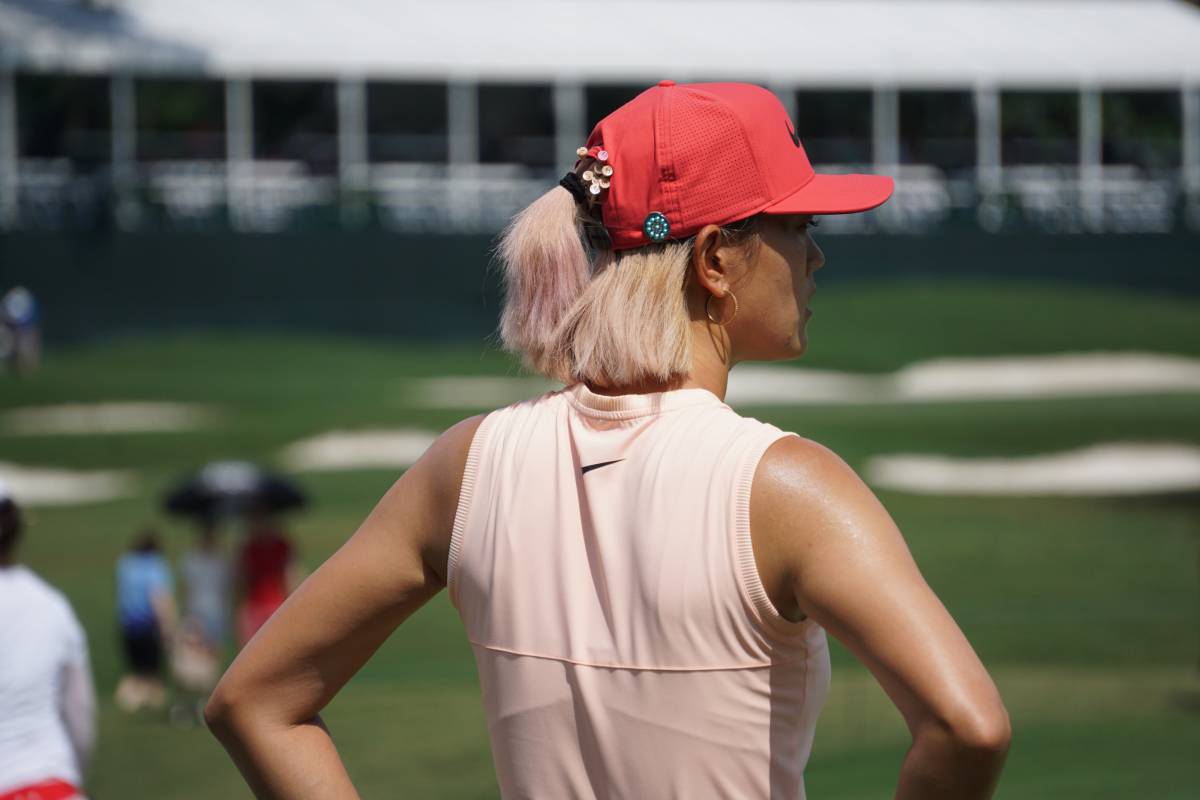
Feature photo: Michelle Wie at the 2018 U.S. Women’s Open by Ben Harpring